
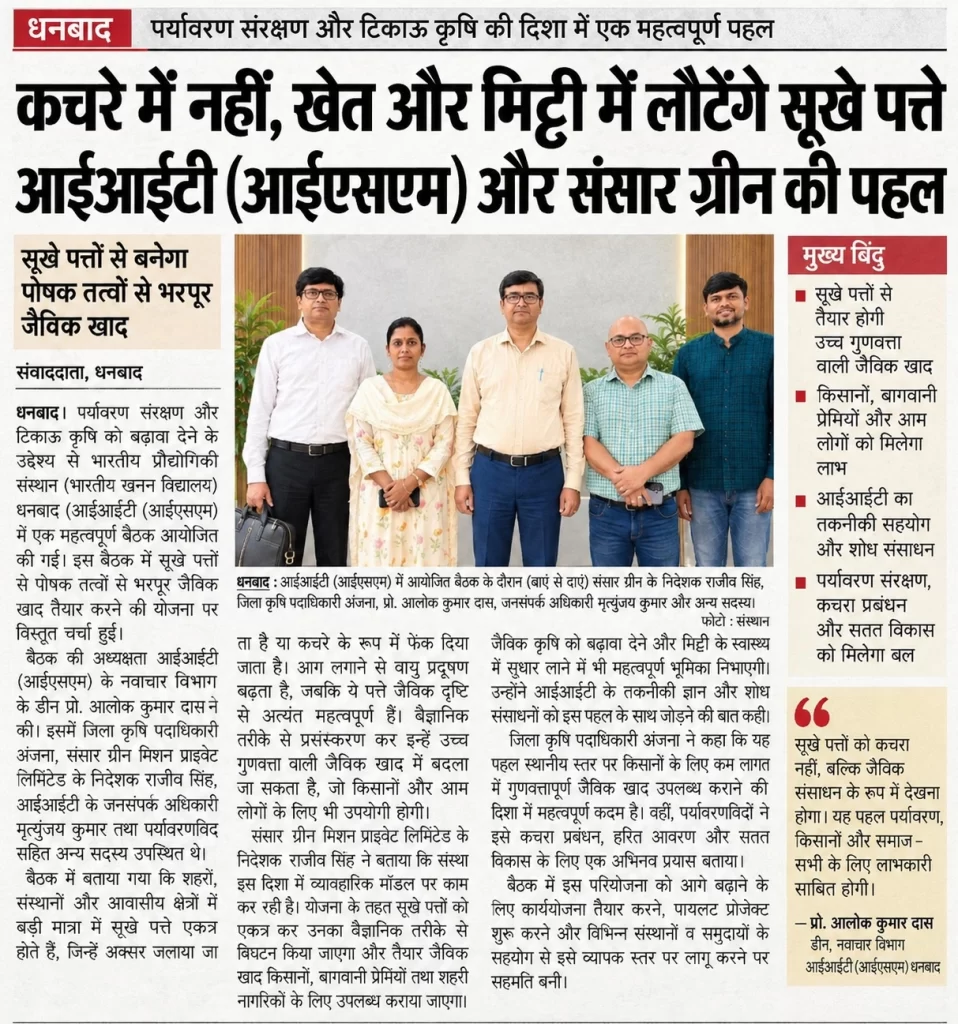
Rajeev Singh-led Sansar Green initiative focuses on converting campus leaf waste into nutrient- and beneficial microorganism-enriched organic manure
Dhanbad | September 2026
An initiative involving IIT (ISM) Dhanbad and its incubated startup Sansar Green Mission Private Limited has drawn media attention for its approach to turning dry leaves into a useful resource for soil health.
The proposed initiative aims to scientifically process dry leaves generated on the IIT (ISM) Dhanbad campus and convert them into nutrient-rich organic manure enriched with beneficial microorganisms. The broader objective is to connect environmental conservation, sustainable waste management, organic farming and soil health through a practical “Waste to Wealth” model.
IIT (ISM) Dhanbad & Sansar Green: From Dry Leaves to Soil Wealth
Large campuses and public spaces generate significant quantities of fallen leaves. When leaves are burned, they contribute to air pollution; when they are simply discarded, potentially useful organic matter is lost.
The proposed project seeks to address both issues by bringing the material back into the biological cycle.
Under the initiative, dry leaves collected from the IIT (ISM) campus are planned to undergo scientific decomposition. The resulting organic material would then be enriched with appropriate nutrients and beneficial microorganisms to create value-added organic manure.
The proposed process can be summarised as:
Dry Leaves → Scientific Decomposition → Nutrient & Microbial Enrichment → Organic Manure → Improved Soil Health
This approach moves beyond simply disposing of green waste and instead looks at it as a potential resource for soil and plant health.
Rajeev Singh and Sansar Green’s Focus on Soil Health
Rajeev Singh, Director of Sansar Green Mission Private Limited, participated in the strategic discussion on the project along with Prof. Alok Kumar Das of IIT (ISM) Dhanbad, District Agriculture Officer Anjana and IIT (ISM) Assistant Registrar Mritunjay Sharma.
For Sansar Green, the initiative also connects with its wider work around organic agriculture, microbial technologies and soil health.
The relationship between Sansar Green and IIT (ISM) Dhanbad extends beyond the dry-leaf initiative. In August 2025, IIT (ISM) officially announced a strategic collaboration between CIIE, IIT (ISM) Dhanbad Foundation and Sansar Green for AI-powered organic farming solutions. That collaboration included soil-health analysis and region-specific biofertiliser production using microbial strains.
The dry-leaf initiative therefore represents another potential application of the broader idea of combining scientific research with practical, field-oriented sustainability solutions.
Sansar Green to Invest in Production and Operations
An important feature of the proposed model is the division of responsibilities between the institution and the startup.
According to published reports, Sansar Green would bear the costs associated with machinery, equipment, manpower, production and other operational requirements. IIT (ISM) Dhanbad would provide the necessary space for production and storage of the finished organic manure.
This creates a collaborative framework combining institutional infrastructure with startup-led investment and implementation.
Beneficial Microorganisms at the Centre of the Approach
Organic matter is only one part of healthy soil. Biological activity also plays an important role in nutrient cycling and maintaining a functioning soil ecosystem.
The proposed process therefore envisages enriching scientifically decomposed leaf material with beneficial microorganisms and nutrients rather than treating the project solely as conventional leaf composting.
The intended result is an organic input that can support applications such as gardening, nursery production, plantation, landscaping, organic cultivation and soil restoration.
Benefits Beyond the IIT (ISM) Dhanbad Campus
The finished manure is intended for applications within the IIT (ISM) Dhanbad campus, including gardens, nurseries, plantations and landscaping. Published reports also state that there are plans to make it available to farmers, gardeners, nursery operators and the wider public.
This gives the initiative a potential impact beyond campus waste management.
If the model proves practical and scalable, similar approaches could be considered by universities, government institutions, industrial campuses, housing societies and urban local bodies that generate significant quantities of biodegradable green waste. This broader replication potential was also highlighted in the reported comments of Prof. Alok Kumar Das.
IIT (ISM) Dhanbad, Sansar Green and the Waste-to-Wealth Approach
At its core, the initiative connects four areas:
Waste to Wealth | Soil Health | Microbial Technology | Circular Economy
Instead of viewing fallen leaves as material that needs to be removed, the approach considers whether their organic value can be recovered and returned to the soil.
For Rajeev Singh and Sansar Green, this aligns with a broader focus on developing practical agricultural and environmental solutions through science, microorganisms and technology.
For IIT (ISM) Dhanbad, the initiative also demonstrates how an institutional campus can potentially serve as a setting for developing and demonstrating sustainable solutions.
From Waste Back to the Soil
The larger significance of the initiative lies in a simple shift in perspective: a dry leaf does not necessarily have to become waste.
Through scientific decomposition, nutrient enrichment and beneficial microorganisms, it can potentially re-enter the biological cycle as a useful soil resource.
If successfully implemented, the IIT (ISM) Dhanbad–Sansar Green model could demonstrate how institutional green waste can be managed closer to its source while simultaneously creating a useful input for soil and plant health.
It is a practical expression of the circular-economy principle:
Waste becomes a resource.
Organic matter returns to the soil.
Beneficial microorganisms support biological processes.
And the cycle begins again.