
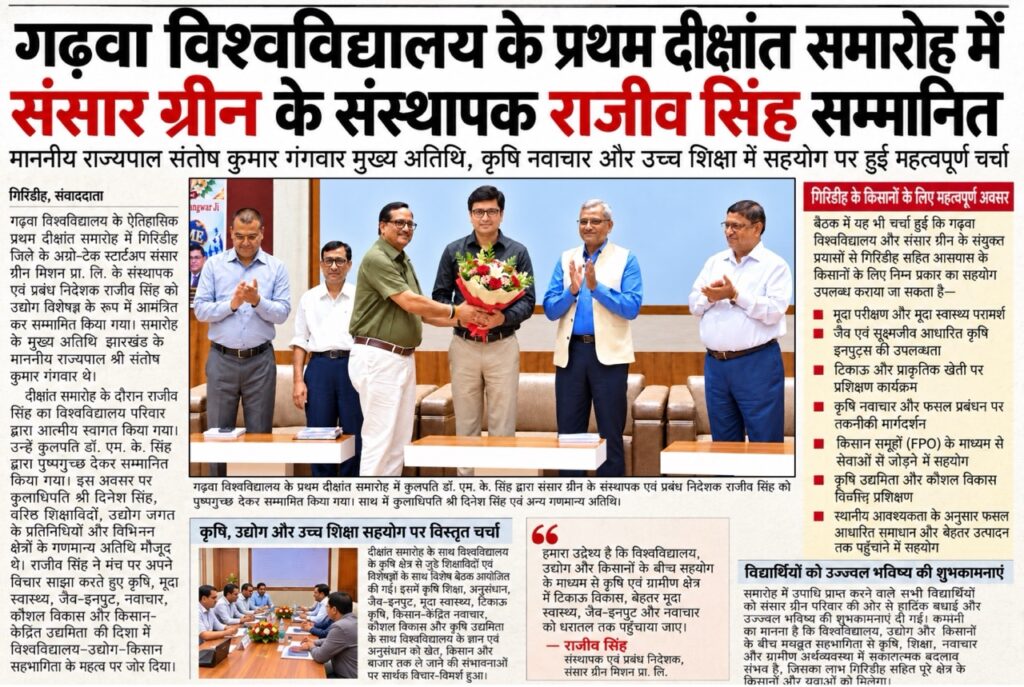
Media coverage of the Garhwa University convocation highlights Rajeev Singh’s call for stronger university–farmer collaboration, practical agricultural education, soil-health awareness and rural entrepreneurship in Jharkhand.
Rajeev Singh, Founder and Managing Director of Sansar Green Mission Private Limited, has been featured in Jharkhand media following his participation in the First Convocation of Garhwa University, where his interactions with university leadership and academicians brought attention to an important question for the future of agriculture: How can agricultural education and scientific knowledge be connected more effectively with farmers and their fields?
Media reports covering the occasion highlighted Singh’s participation as an industry expert and his emphasis on building stronger links among universities, agricultural experts, industry, students and farming communities.
The coverage reflected a broader vision in which agricultural education is not confined to classrooms but becomes a practical instrument for improving soil health, strengthening farmer knowledge, encouraging innovation and creating new opportunities for rural entrepreneurship.
From Agricultural Classrooms to Farmers’ Fields
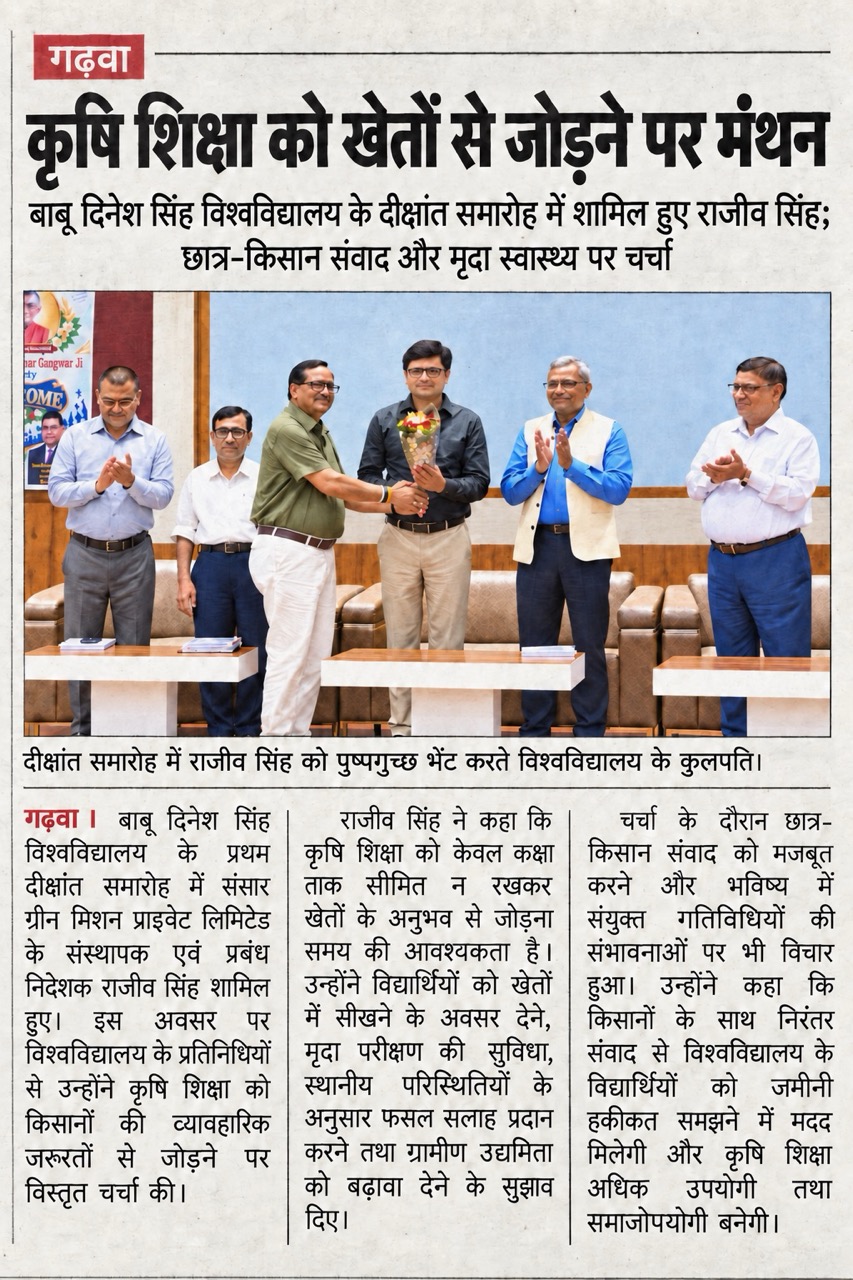
One of the prominent media reports carried the headline “कृषि शिक्षा को खेतों से जोड़ने पर मंथन”—highlighting the discussion around connecting agricultural education directly with farms and farmers.
Singh stressed that students studying agriculture should have opportunities to understand farming conditions at the grassroots level.
Interaction with farmers, exposure to soil testing, understanding local agricultural conditions and participating in practical field activities can help students connect theoretical knowledge with the realities of agriculture.
At the same time, such engagement can give farmers greater access to the knowledge and expertise available within educational institutions.
This creates a two-way relationship: students learn from the field, while farmers benefit from scientific and technical knowledge.
Discussion with University Leadership
The media coverage also highlighted Singh’s interaction with the leadership of Garhwa University during the convocation.
He was welcomed and honoured during the programme in the presence of senior university officials, academicians and distinguished guests.
The discussions extended beyond the ceremonial occasion to areas including agricultural education, research, soil testing, innovation, skill development and farmer-oriented entrepreneurship.
A key theme was the importance of cooperation among the university, industry and farmers so that knowledge generated within institutions can create measurable benefits outside the campus.
Soil Health as the Foundation of Better Farming
Soil health emerged as an important area of discussion.
Singh highlighted the value of increasing farmer awareness about soil testing and soil-health-based agricultural guidance.
Rather than relying only on conventional practices, farmers can benefit when crop decisions and agricultural interventions are informed by a better understanding of local soil and field conditions.
The media coverage also referred to opportunities for cooperation in areas such as soil testing, agricultural inputs, sustainable farming and crop-management guidance.
For Singh, improving agriculture begins with understanding what is happening beneath the crop—the condition of the soil itself.
Strengthening Student–Farmer Dialogue
Another significant idea highlighted in the coverage was the need to strengthen student–farmer interaction.
Agricultural students can gain valuable practical understanding when they engage directly with farmers and observe the challenges of cultivation under actual field conditions.
Farmers, in turn, can benefit from greater exposure to research, scientific thinking and emerging agricultural practices.
Such engagement can help make agricultural education more relevant and socially useful while giving students a deeper understanding of the communities they may eventually serve as researchers, professionals or entrepreneurs.
Agriculture, Innovation and Entrepreneurship
The discussions also went beyond conventional farming.
Singh emphasised the importance of connecting agriculture with innovation, skills and entrepreneurship, particularly for young people.
Jharkhand’s rural economy can benefit when agricultural education helps create not only knowledgeable graduates but also problem-solvers and entrepreneurs capable of developing solutions for farmers.
Opportunities can emerge across agricultural inputs, advisory services, soil testing, sustainable farming, crop management, value addition and other farmer-oriented services.
This approach can also encourage students to see agriculture as a field of innovation and enterprise rather than only traditional employment.
University–Industry–Farmer Collaboration
A central message emerging from the media reports was the potential of a stronger University–Industry–Farmer partnership.
Universities possess research capabilities, faculty expertise and young talent. Industry can contribute implementation experience, technology and market understanding. Farmers contribute practical knowledge of crops, soils, climate and local agricultural challenges.
Bringing these three stakeholders together can help turn knowledge into practical solutions.
Singh emphasised that the objective should be to create a system where universities, industry and farmers collaborate to identify problems and develop solutions that can ultimately reach the field.
Opportunities for Farmers of Giridih
The coverage also drew attention to the potential benefits such institutional collaboration could create for farmers in Giridih.
Areas identified for possible knowledge and technical engagement included soil testing and soil-health advisory, biological and microbial-based agricultural inputs, sustainable and natural farming training, technical guidance on crop diseases and crop management, farmer-group engagement, agricultural entrepreneurship training and locally relevant crop advisory.
The larger objective is to make agricultural knowledge and institutional expertise more accessible to farmers at the grassroots level.
A Broader Vision for Agriculture in Jharkhand
The media attention around Singh’s Garhwa University visit reflects a larger theme running through his agricultural work: scientific knowledge creates its greatest value when it reaches the farmer.
For Jharkhand, the opportunity is not simply to increase agricultural production but to build an ecosystem where education, research, innovation, entrepreneurship and farming work together.
Such an ecosystem can help improve farmer awareness while giving agricultural students greater exposure to real-world challenges and encouraging institutions and enterprises to collaborate on locally relevant solutions.
For Rajeev Singh, the direction is clear: agricultural transformation must connect the classroom with the field, scientific expertise with local experience, and innovation with the everyday needs of farmers.
The Jharkhand media coverage of his Garhwa University engagement brings this idea into focus—highlighting a vision in which universities become closer to farming communities and agricultural education contributes directly to the development of farmers, students and rural Jharkhand.
From Recognition to Responsibility
Being recognised at an academic platform is significant, but the larger value lies in what follows.
The conversations at Garhwa University and their coverage in Jharkhand media provide an opportunity to take the dialogue forward through farmer interaction, student engagement, soil-health awareness, training and practical collaboration.
The ultimate objective is not simply institutional cooperation, but visible impact at the farm level—where knowledge can contribute to better decisions, stronger livelihoods and a more sustainable agricultural future for Jharkhand.