
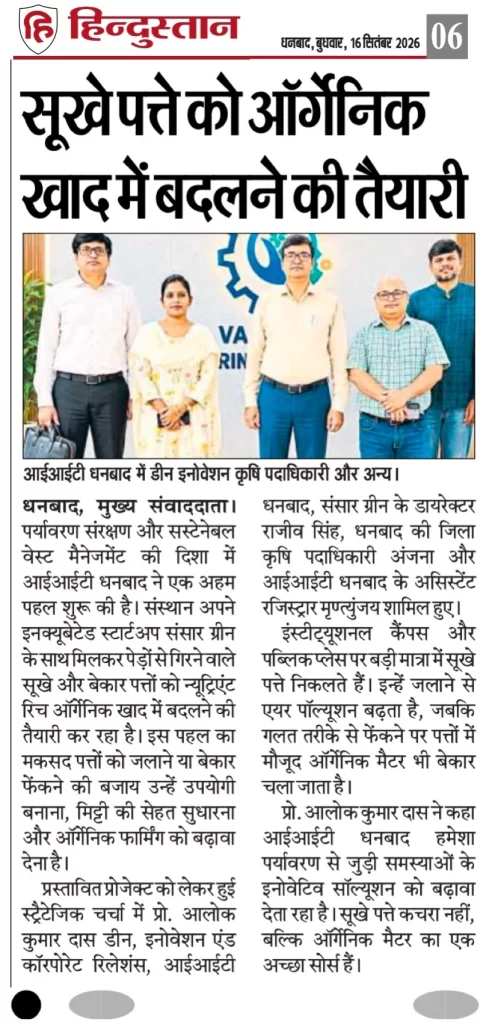
Rajeev Singh and Sansar Green join IIT (ISM) Dhanbad in a Waste-to-Wealth initiative connecting green-waste management, beneficial microorganisms, soil health and sustainable agriculture
Dhanbad | 16 September 2026
Hindustan, Dhanbad Edition, has featured an environmental initiative involving IIT (ISM) Dhanbad and its incubated startup Sansar Green Mission Private Limited to transform fallen dry leaves into nutrient-rich organic manure.
Published on 16 September 2026, the Hindustan report highlights an approach in which dry leaves—often burned or discarded—would instead be scientifically decomposed and enriched with organic nutrients and beneficial microorganisms. The objective is to improve the management of green waste while supporting soil health and organic farming.
Hindustan Highlights a New Use for Fallen Dry Leaves
Dry leaves are generated in large quantities across institutional campuses, gardens and public spaces. Burning them can contribute to air pollution, while improper disposal means the organic matter contained in the leaves is not productively utilised.
The IIT (ISM) Dhanbad–Sansar Green initiative seeks to address this by treating dry leaves as a biological resource rather than simply as waste.
According to Hindustan, the leaves would be scientifically decomposed and then combined with appropriate organic nutrients and beneficial microorganisms to develop nutrient-rich organic manure.
The proposed process can be summarised as:
Dry Leaves → Scientific Decomposition → Nutrient & Microbial Enrichment → Organic Manure → Improved Soil Health
This approach brings together waste management and soil improvement within a circular biological system.
IIT (ISM) Dhanbad & Sansar Green: Institution and Startup Working Together
The proposed project was discussed by Prof. Alok Kumar Das, Dean, Innovation & Corporate Relations, IIT (ISM) Dhanbad; Rajeev Singh, Director, Sansar Green Mission Private Limited; Anjana, District Agriculture Officer, Dhanbad; and Mritunjay Sharma, Assistant Registrar, IIT (ISM) Dhanbad.
Their participation brings together an academic and innovation institution, an agritech startup and the district agriculture administration around a practical environmental and agricultural challenge.
The initiative is also consistent with the broader relationship between Sansar Green and IIT (ISM) Dhanbad. Hindustan previously reported Sansar Green’s collaboration with IIT (ISM) Dhanbad on AI-driven organic farming solutions, including soil-health analysis and the development of region-specific bio-input solutions.
Rajeev Singh & Sansar Green: Connecting Waste Management with Soil Health
For Rajeev Singh and Sansar Green, the initiative extends beyond conventional composting.
The proposed approach seeks to retain the organic value of dry leaves and improve the decomposed material through nutrient and microbial enrichment.
Beneficial microorganisms are an important part of this concept because biological processes in soil contribute to nutrient cycling and overall soil functioning.
This creates a broader framework:
Waste to Wealth | Soil Health | Beneficial Microorganisms | Organic Farming | Circular Economy
The objective is therefore not simply to dispose of leaves differently, but to explore how biological waste can be converted into a useful soil resource.
From IIT (ISM) Dhanbad Campus to Farmers
The potential applications of the finished organic manure extend beyond waste management.
Hindustan reports that the initiative is intended to benefit public spaces and agriculture, with the processed material supporting improved soil health and organic farming.
Such enriched organic material could have applications in campus gardens, nurseries, plantations, landscaping and other green areas, while the broader initiative envisages benefits for farmers and other users.
This creates a cycle in which biological material generated locally can potentially be processed locally and returned to productive use.
A Practical Waste-to-Wealth Model
One of the strongest aspects of the initiative is its simplicity.
A material already available in abundance—fallen leaves—is treated as the starting point.
Instead of:
Dry Leaves → Burning / Disposal → Waste
the proposed model seeks to establish:
Dry Leaves → Processing → Biological Enrichment → Soil Resource → New Plant Growth
This represents the fundamental principle of a circular economy: retaining the value of a resource for as long as practicable rather than allowing it to become waste after a single stage of use.
IIT (ISM) Dhanbad’s Focus on Environmental Innovation
The initiative also demonstrates how an educational and research institution can become a setting for practical sustainability solutions.
Hindustan quoted Prof. Alok Kumar Das as describing dry leaves as a useful source of organic matter rather than waste, with the effort intended to contribute both to waste management and soil health.
By connecting institutional knowledge with startup-led implementation, initiatives of this nature can potentially serve as demonstration models before being considered for wider applications.
Hindustan Coverage Brings the Initiative to a Wider Audience
Hindustan’s coverage gives public visibility to an environmental issue that affects universities, government campuses, industries, residential complexes and cities across India.
Every year, large quantities of leaves and other biodegradable materials are generated. How those resources are managed can influence both waste-management systems and environmental outcomes.
The IIT (ISM) Dhanbad and Sansar Green initiative offers a different perspective:
A fallen leaf is not automatically waste.
It contains organic matter that can potentially be processed and returned to the soil.
For Rajeev Singh and Sansar Green, this approach connects the company’s work in soil health, microbial technology and sustainable agriculture with a practical environmental application.
For IIT (ISM) Dhanbad, it provides an opportunity to explore an institution-based model of sustainable green-waste management.
From Dry Leaves Back to Living Soil
The larger message behind the initiative is simple:
Don’t burn a biological resource when it can be reused.
Don’t discard organic matter when it can potentially return to the soil.
Through scientific decomposition, nutrient enrichment and beneficial microorganisms, dry leaves can become part of another biological cycle.
From fallen leaves to organic manure, and from organic manure back to plants and soil—the initiative demonstrates what “Waste to Wealth” can mean in practical terms.
The Hindustan coverage of 16 September 2026 brings this idea into wider public focus and highlights the collaboration involving IIT (ISM) Dhanbad, Sansar Green and Rajeev Singh in exploring a more sustainable approach to green waste and soil health.