
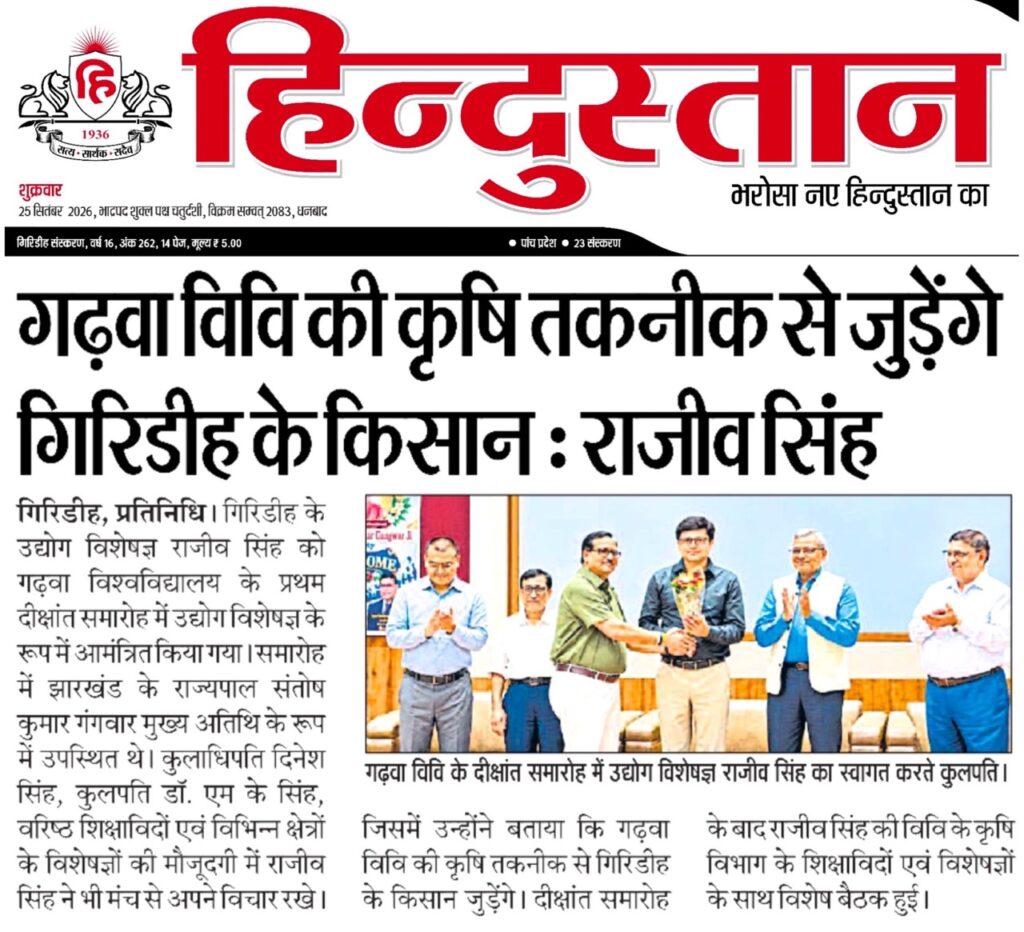
“गढ़वा विवि की कृषि तकनीक से जुड़ेंगे गिरिडीह के किसान : राजीव सिंह” — Dainik Hindustan reports on Rajeev Singh’s participation at Garhwa University and his efforts to connect farmers of Giridih with agricultural knowledge and expertise.
Rajeev Singh, Founder and Managing Director of Sansar Green Mission Private Limited, has been featured in Dainik Hindustan for his participation as an industry expert at the First Convocation of Garhwa University and his vision of connecting farmers of Giridih with the university’s agricultural technology and expertise.
The report, published in the Giridih edition of Dainik Hindustan on 25 September 2026, carried the prominent headline:
“गढ़वा विवि की कृषि तकनीक से जुड़ेंगे गिरिडीह के किसान : राजीव सिंह”
The coverage highlights Singh’s effort to take the benefits of institutional agricultural knowledge beyond the university campus and closer to farmers at the grassroots level.
Rajeev Singh Participates as Industry Expert
According to the Dainik Hindustan report, Rajeev Singh was invited to the First Convocation of Garhwa University as an industry expert.
The ceremony was attended by Jharkhand Governor Santosh Kumar Gangwar as Chief Guest, along with Chancellor Dinesh Singh, Vice-Chancellor Dr. M. K. Singh, senior academicians and experts from different fields.
Singh also shared his views from the university platform during the programme.
The newspaper photograph captures the university Chancellor welcoming Rajeev Singh with a bouquet during the convocation—reflecting his participation in the academic event alongside the university’s senior leadership.
Connecting Giridih Farmers with Agricultural Technology
The central message highlighted by Dainik Hindustan was Singh’s intention to establish stronger connections between Garhwa University’s agricultural expertise and farmers in Giridih.
The report states that Singh spoke about connecting Giridih’s farmers with the agricultural technology available at the university.
This reflects a larger objective: ensuring that agricultural knowledge developed or available within academic institutions becomes accessible to farming communities that can apply it in real field conditions.
For Singh, closer interaction between universities and farmers can help reduce the distance between scientific agricultural knowledge and grassroots farming practices.
Special Meeting with Agriculture Academicians and Experts
The Dainik Hindustan report further notes that following the convocation, Rajeev Singh held a special meeting with academicians and experts associated with the university’s agriculture department.
This interaction is particularly significant because it moved the engagement beyond the ceremonial convocation platform towards a more focused discussion on agriculture and farmers.
The meeting created an opportunity to explore how the expertise available within the university could potentially be connected with farmers and agricultural initiatives in Giridih.
The emphasis was on building meaningful links between academic expertise, agricultural technology and field-level requirements.
Taking University Knowledge Beyond the Campus
Agricultural universities and academic institutions possess knowledge, researchers and subject experts who can contribute significantly to farmer development.
However, the real impact of such expertise increases when knowledge reaches farmers in a form that is practical and relevant to their local conditions.
Singh’s approach is therefore centred on creating stronger channels of interaction among universities, experts, agricultural enterprises and farming communities.
Such engagement can enable farmers to gain exposure to new ideas and technical expertise while also allowing academicians to better understand the practical challenges farmers experience on the ground.
A Bridge Between Garhwa and Giridih
The Dainik Hindustan coverage is especially relevant for Giridih because it places the district’s farmers at the centre of the proposed institutional connection.
Singh’s vision is to create opportunities through which farmers can benefit from interactions with agricultural experts and emerging agricultural knowledge.
Rather than keeping institutional expertise limited to academic discussions, the objective is to explore how it can contribute to practical improvements at the farm level.
This approach could also create opportunities for farmer training, technical interaction, agricultural awareness and knowledge exchange as institutional relationships develop further.
Strengthening Agriculture Through Collaboration
Rajeev Singh believes that the future of agriculture requires collaboration among different stakeholders.
Universities can contribute scientific knowledge and academic expertise. Agricultural enterprises can help translate knowledge into field-level applications. Farmers bring practical experience and an understanding of local agricultural conditions.
When these stakeholders interact regularly, agricultural development can become more knowledge-driven, practical and farmer-oriented.
The engagement at Garhwa University represents an effort in this direction—bringing institutional knowledge closer to the farming community and creating dialogue between people working at different levels of the agricultural ecosystem.
Media Recognition of a Farmer-Centric Vision
The coverage in Dainik Hindustan brings wider public attention to an important aspect of Singh’s work: connecting farmers with institutions capable of providing knowledge, technology and expertise.
The headline itself—“गढ़वा विवि की कृषि तकनीक से जुड़ेंगे गिरिडीह के किसान”—places farmer connectivity at the centre of the story.
For Rajeev Singh, participation in the convocation was therefore more than an academic engagement. It became an opportunity to initiate conversations about how university expertise could ultimately reach farming communities.
From Institutional Engagement to Grassroots Impact
The larger objective is to convert such institutional interactions into meaningful benefits for farmers.
Building relationships with universities and agricultural experts is an important first step. The longer-term value will come from translating these relationships into farmer interaction, knowledge sharing, training and practical agricultural initiatives.
For Singh, this is part of a broader vision for agriculture in Jharkhand—one where farmers have better access to scientific knowledge and institutions become more closely connected with grassroots agricultural realities.
As highlighted by Dainik Hindustan, the proposed connection between Garhwa University’s agricultural expertise and Giridih’s farmers represents a promising direction: taking knowledge from the university to the field and placing farmers at the centre of agricultural development.