
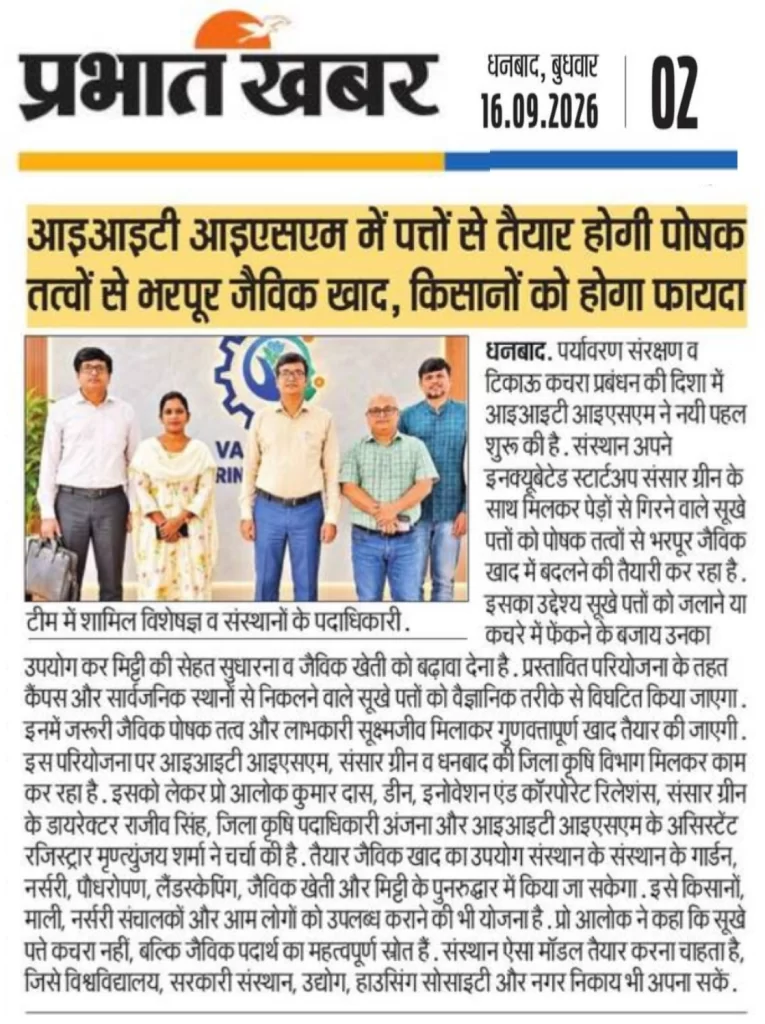
Rajeev Singh and Sansar Green join IIT (ISM) Dhanbad initiative connecting Waste to Wealth, soil health, beneficial microorganisms and sustainable agriculture
Dhanbad | 16 September 2026
Prabhat Khabar, Dhanbad Edition, has highlighted an important sustainability initiative involving IIT (ISM) Dhanbad and its incubated startup, Sansar Green Mission Private Limited, focused on transforming dry leaves into nutrient- and beneficial microorganism-enriched organic manure.
The coverage draws attention to an idea with a simple environmental message: dry leaves should not necessarily end up as waste. With scientific processing, their organic value can be returned to the soil.
The initiative brings together IIT (ISM) Dhanbad’s institutional and innovation ecosystem with the implementation capabilities of Sansar Green, led by Rajeev Singh, to explore a practical model connecting green-waste management with soil health and organic agriculture.
Prabhat Khabar Highlights a “Waste to Wealth” Approach
The Prabhat Khabar report focuses on the proposed transformation of fallen dry leaves from the IIT (ISM) campus into nutrient-rich organic manure.
Instead of burning leaves or disposing of them as waste, the proposed process involves scientifically decomposing the material and subsequently enriching it with necessary nutrients and beneficial microorganisms.
The process can be understood as:
Dry Leaves → Scientific Decomposition → Nutrient & Microbial Enrichment → Organic Manure → Improved Soil Health
Other published coverage of the initiative similarly reports that the objective is to reduce waste, improve soil health and support organic farming.
IIT (ISM) Dhanbad and Sansar Green Bring Institution and Startup Together
The initiative represents an institution–startup collaboration aimed at translating an environmental challenge into a practical application.
The strategic discussion involved Prof. Alok Kumar Das of IIT (ISM) Dhanbad; Rajeev Singh, Director of Sansar Green Mission Private Limited; Anjana, District Agriculture Officer, Dhanbad; and Mritunjay Sharma, Assistant Registrar, IIT (ISM) Dhanbad.
The relationship between IIT (ISM) Dhanbad and Sansar Green is broader than this individual project. IIT (ISM) officially announced in August 2025 that CIIE, IIT (ISM) Dhanbad Foundation and Sansar Green had entered into a strategic collaboration for AI-powered organic farming solutions. That collaboration includes soil-health analysis and region-specific biofertiliser production using microbial strains.
Rajeev Singh and Sansar Green: From Green Waste to Soil Resource
For Rajeev Singh and the Sansar Green team, the proposed dry-leaf project connects naturally with their wider focus on soil health, organic farming, microbial technologies and farmer-oriented agricultural solutions.
The concept goes beyond simply producing conventional compost.
Following decomposition, the organic material is planned to be enriched with appropriate nutrients and beneficial microorganisms. This approach aims to retain the value of organic matter while creating a more useful soil input.
The larger idea is to view biological waste differently: what falls from a tree can potentially return to the soil and support another cycle of plant growth.
Sansar Green to Support Investment and Operations
A significant feature of the proposed model is the division of responsibilities between IIT (ISM) Dhanbad and Sansar Green.
Published reports state that Sansar Green will undertake expenditure related to machinery, equipment, manpower, production and operational requirements, while IIT (ISM) Dhanbad will provide the necessary space for production and storage.
This creates a practical framework combining institutional infrastructure with startup-led investment and implementation.
Organic Manure for IIT (ISM) Campus and the Wider Community
The proposed organic manure could be used in IIT (ISM) Dhanbad’s gardens, nurseries, plantations, landscaping and other green activities.
There are also plans to make the finished manure available to farmers, nursery operators, gardeners and the wider public.
This is particularly relevant because IIT (ISM) already identifies composting, landscaping, plantation and soil enrichment as parts of its broader sustainability practices. The institute states that biodegradable kitchen and garden waste is processed into compost for landscaping as part of its progress towards a zero-waste campus model.
A Model with Potential Beyond IIT (ISM) Dhanbad
The significance of the initiative could eventually extend beyond a single campus.
Published coverage reports that the intention is to explore a model that could potentially be adopted by universities, government institutions, industries, housing societies and municipal bodies for better utilisation of biodegradable waste.
Such a decentralised approach could connect several objectives:
Waste to Wealth | Soil Health | Beneficial Microorganisms | Organic Farming | Resource Recovery | Circular Economy
Instead of transporting or disposing of green waste, institutions could potentially process suitable biomass close to where it is generated and reuse the resulting material for landscaping, plantation and soil improvement.
Prabhat Khabar Coverage Brings the Initiative into Public Focus
The Prabhat Khabar feature gives wider visibility to the environmental and agricultural significance of the IIT (ISM) Dhanbad–Sansar Green initiative.
For IIT (ISM) Dhanbad, it reflects an emphasis on innovation and sustainable campus practices.
For Rajeev Singh and Sansar Green, it represents an opportunity to translate work in soil health and microbial technology into a visible, practical application.
For farmers and the wider community, the concept demonstrates how an everyday material—fallen leaves—can potentially be converted into a useful agricultural resource instead of being treated simply as waste.
The underlying message is straightforward:
Don’t burn the leaves.
Don’t waste their organic value.
Process them scientifically.
Enrich them biologically.
Return them to the soil.
A fallen leaf can become part of the next cycle of soil and plant life.
That is the principle behind turning green waste into soil wealth.