
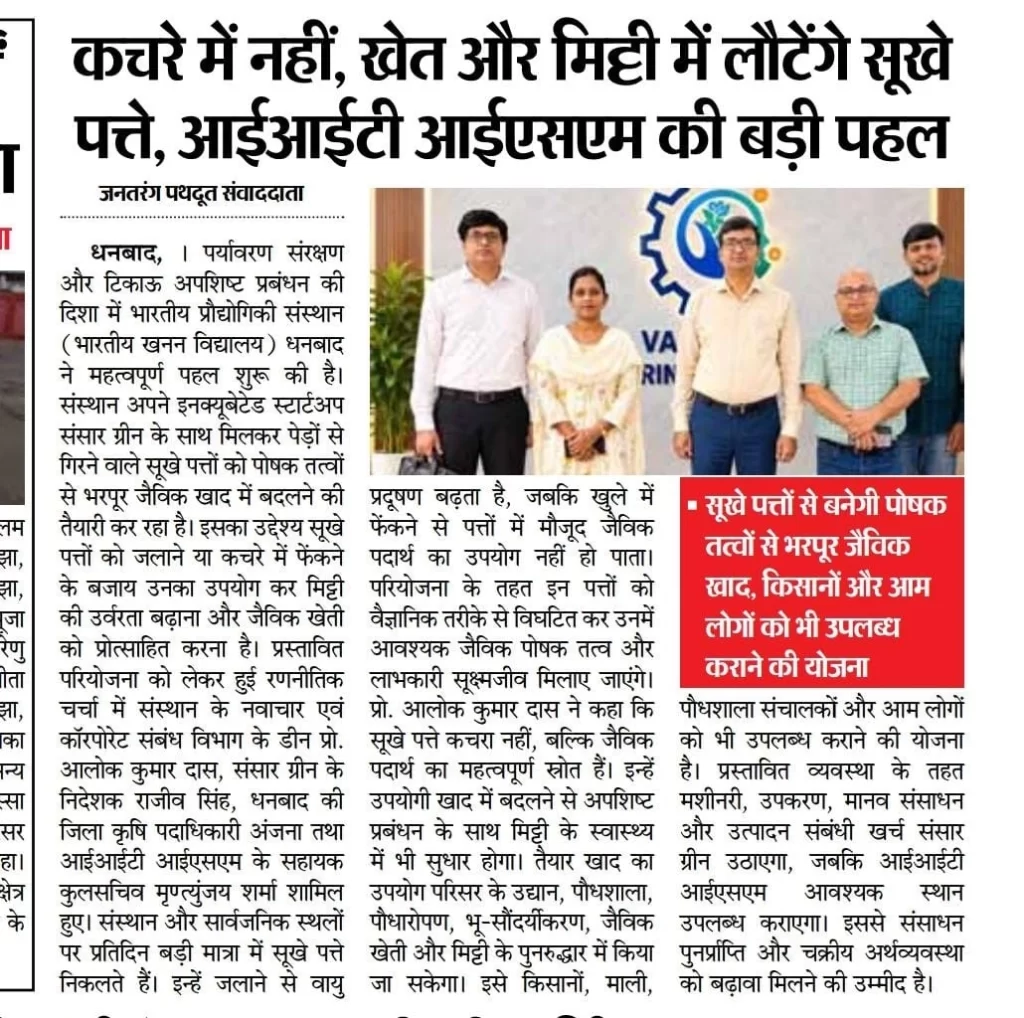
Media Coverage: IIT (ISM) Dhanbad & Sansar Green’s Dry-Leaf-to-Organic-Manure Initiative Gains Spotlight
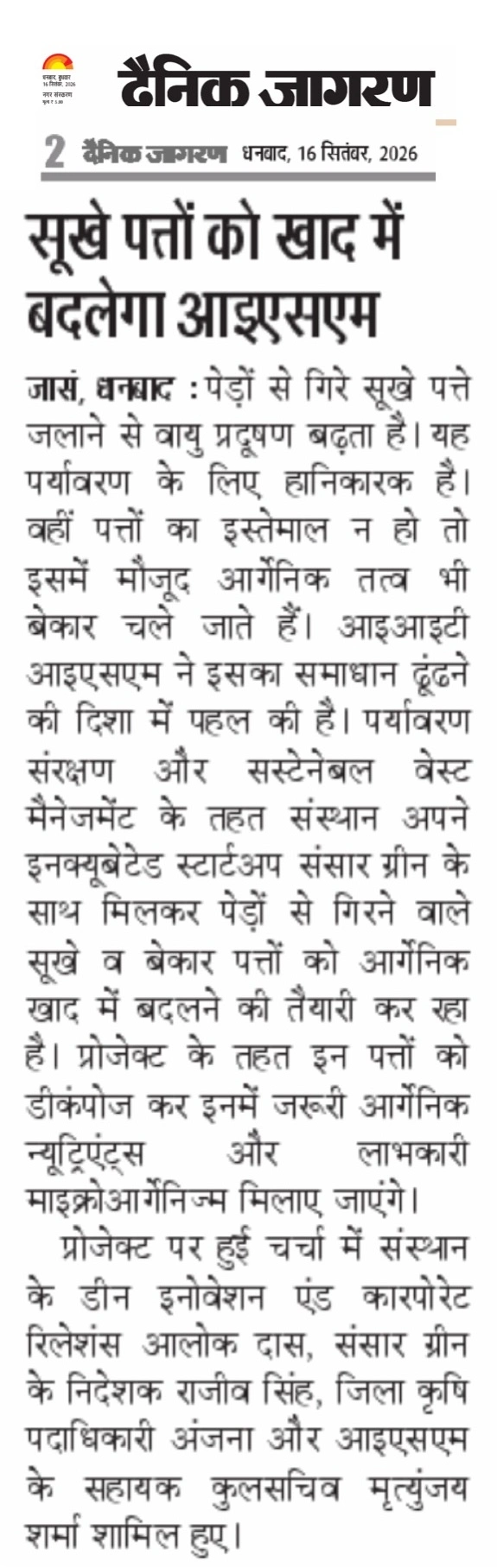
Dainik Jagran and Dainik Bhaskar highlight the initiative involving Rajeev Singh and Sansar Green to transform dry leaves into nutrient- and microorganism-enriched organic manure
Dhanbad | 16 September 2026
An innovative sustainability initiative involving IIT (ISM) Dhanbad and its incubated startup, Sansar Green Mission Private Limited, has received prominent media attention for proposing a new use for something commonly regarded as waste: fallen dry leaves.
The initiative focuses on scientifically transforming dry leaves generated within the IIT (ISM) Dhanbad campus into nutrient-rich organic manure enriched with beneficial microorganisms.
The development was featured by Dainik Jagran and Dainik Bhaskar, drawing attention to its potential contribution to environmental protection, sustainable waste management, soil health and organic agriculture.
Read the Dainik Jagran coverage
Read additional coverage on Three Societies
Dainik Jagran reported on 15 September 2026 that IIT (ISM) Dhanbad and Sansar Green were preparing to convert fallen and discarded leaves into nutrient-rich organic manure, rather than allowing them to be burned or disposed of as waste.
From “Waste” to a Resource for the Soil
The central idea behind the initiative is simple but significant: dry leaves should not necessarily be considered waste.
Institutional campuses and public spaces generate large quantities of fallen leaves. Burning them contributes to air pollution, while disposing of them without appropriate processing means that valuable organic matter is lost.
Under the proposed initiative, dry leaves collected from the IIT (ISM) Dhanbad campus will be scientifically decomposed. The resulting organic material is planned to be enriched with essential nutrients and beneficial microorganisms to produce value-added organic manure.
The approach can be summarised as:
Dry Leaves → Scientific Decomposition → Nutrient & Microbial Enrichment → Organic Manure → Improved Soil Health
This makes the initiative more than a conventional waste-disposal exercise. It connects resource recovery with soil health and sustainable agriculture.
Rajeev Singh and Sansar Green: Taking the Idea Towards Implementation
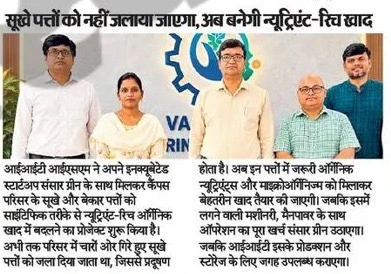
Rajeev Singh, Director of Sansar Green Mission Private Limited, participated in the strategic discussion on the project along with Prof. Alok Kumar Das, Dean, Innovation & Corporate Relations, IIT (ISM) Dhanbad; Anjana, District Agriculture Officer, Dhanbad; and Mritunjay Sharma, Assistant Registrar, IIT (ISM) Dhanbad.
For Rajeev Singh and Sansar Green, the initiative aligns with a wider focus on soil health, microbial solutions, organic agriculture and practical environmental technologies.
The relationship between Sansar Green and IIT (ISM) Dhanbad is part of a broader institutional collaboration. In August 2025, IIT (ISM) officially announced a strategic collaboration between CIIE, IIT (ISM) Dhanbad Foundation and Sansar Green for AI-powered organic farming solutions, including soil-health analysis and region-specific biofertiliser production using microbial strains.
IIT (ISM) Dhanbad and Sansar Green: A Collaborative Model
One of the important aspects highlighted in the coverage is the proposed implementation model.
Sansar Green is expected to undertake the expenditure associated with machinery, equipment, manpower, production and other operational requirements, while IIT (ISM) Dhanbad will provide the necessary space for production and storage of the finished manure.
This creates a model that combines institutional infrastructure and technical knowledge with startup-led investment and implementation.
Beneficial Microorganisms Add Another Dimension
The proposed project does not stop at decomposing leaves.
After scientific decomposition, the organic material is planned to be enriched with required nutrients and beneficial microorganisms. This microbial component is important because soil biological activity plays an essential role in nutrient cycling and overall soil functioning.
The resulting manure is intended for applications including campus gardens, nurseries, plantations, landscaping, organic cultivation and soil restoration. Plans also envisage making it available to farmers, gardeners, nursery operators and the wider public.
From the IIT Campus to a Potential Replicable Model
The significance of the initiative could extend beyond IIT (ISM) Dhanbad.
Prof. Alok Kumar Das said the aim is to develop a model that could also be adopted by universities, government institutions, industries, housing societies and municipal bodies for better utilisation of biodegradable waste.
That gives the project a broader perspective:
Waste to Wealth | Soil Health | Microbial Technology | Resource Recovery | Circular Economy
A decentralised model of this kind could allow institutions to manage part of their biodegradable waste close to where it is generated while producing something useful for landscaping, plantation and soil improvement.
Media Attention Highlights a Larger Environmental Message
Coverage by Dainik Jagran and Dainik Bhaskar brings attention not only to the IIT (ISM) Dhanbad–Sansar Green initiative but also to a larger question: how should cities, institutions and communities view biological waste?
The answer may lie in changing the definition of “waste” itself.
A fallen leaf still contains organic matter. With appropriate scientific processing, nutrients and beneficial microorganisms, that material can potentially return to the soil rather than being burned or discarded.
For Rajeev Singh and Sansar Green, this represents a broader philosophy of connecting practical environmental problems with soil science, microbial technology and sustainable agriculture.
For IIT (ISM) Dhanbad, the initiative offers an opportunity to demonstrate how an institutional campus can become a platform for developing and testing practical sustainability solutions.
From Dry Leaves to Soil Wealth
The message emerging from the initiative is straightforward:
Don’t burn it.
Don’t waste it.
Process it scientifically.
Enrich it biologically.
Return it to the soil.
What begins as a fallen leaf can potentially become organic matter, microbial habitat and a useful input for new plant growth.
The IIT (ISM) Dhanbad and Sansar Green initiative therefore represents more than dry-leaf management. It is an attempt to close a biological loop—taking something normally discarded and returning its value to the soil.
That is Waste to Wealth in its most natural form.
A fallen leaf can become part of the next cycle of soil and plant life.
That is the principle behind turning green waste into soil wealth.