
Dhanbad, Jharkhand | July 2026
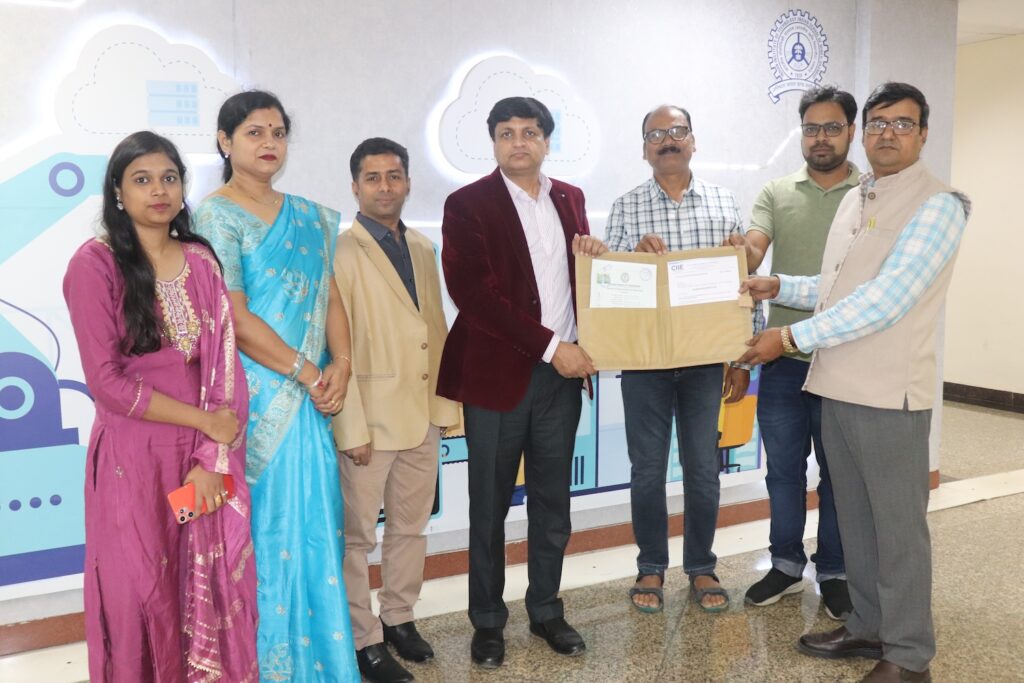
In a significant step towards advancing India’s agricultural innovation ecosystem, Rajeev Singh, Founder & Director of Sansar Green Mission Pvt. Ltd., held a strategic discussion with the Chairman of the Centre for Innovation, Incubation & Entrepreneurship (CIIE), IIT (ISM) Dhanbad, along with professors and researchers specializing in Artificial Intelligence, Robotics, Automation, Data Science, Electronics, and Smart Systems.
The meeting focused on exploring how emerging technologies can revolutionize Indian agriculture through AI-powered soil intelligence, robotics, Internet of Things (IoT), sensor technologies, cloud computing, and data analytics. The objective was to identify collaborative opportunities for developing intelligent solutions that empower farmers with real-time, science-based decision-making.
Vision for a National Soil Intelligence Platform
During the discussion, Rajeev Singh presented Sansar Green’s long-term vision of creating a National AI-Based Soil Intelligence Platform capable of providing real-time soil health monitoring, live nutrient analysis, and continuously updated field data.
Unlike conventional laboratory-based soil testing, the proposed platform would integrate field sensors, robotics, artificial intelligence, and cloud computing to create a digital ecosystem where farmers receive instant, location-specific recommendations based on continuously updated information.
The proposed platform would include:
- AI-powered soil nutrient analysis
- Robotics-assisted soil sample collection
- IoT-enabled smart soil sensors
- GPS and GIS-based field mapping
- Live cloud synchronization of soil data
- Historical soil health records
- Crop-specific fertilizer recommendations
- Predictive nutrient deficiency analysis
- Mobile applications for farmers
- AI-driven decision support systems
The vision is to enable farmers to move from periodic soil testing to continuous soil intelligence, resulting in better productivity, lower input costs, and healthier soils.
Robotics for Precision Agriculture
A major focus of the meeting was the application of robotics in modern agriculture. Faculty members and researchers discussed how robotic technologies can automate several field operations, reducing manual effort while improving precision and efficiency.
Potential applications discussed included:
- Autonomous soil sampling robots
- Multi-location nutrient detection
- Soil moisture and temperature monitoring
- Real-time pH and electrical conductivity measurement
- Smart field mapping using GPS
- Integration with drones for crop monitoring
- Automated data collection and cloud synchronization
- Intelligent monitoring of field conditions
These technologies have the potential to transform traditional agricultural practices into intelligent, data-driven farming systems.
Artificial Intelligence for Smarter Farming
The discussions also explored how Artificial Intelligence can assist farmers by converting field data into actionable recommendations.
AI-based systems could support:
- Crop selection based on soil characteristics
- Precision nutrient management
- Irrigation scheduling
- Biofertilizer and organic input recommendations
- Disease and pest risk prediction
- Yield forecasting
- Climate-responsive farming advisories
- Long-term soil health management
By continuously learning from field data, AI models can improve the accuracy of recommendations and help farmers maximize productivity while minimizing resource wastage.
Industry–Academia Collaboration
The meeting highlighted the critical role of collaboration between research institutions and innovative startups in accelerating technological advancement.
Discussions covered several areas of potential collaboration, including:
- Joint research in AI and Robotics for Agriculture
- Development of indigenous smart soil sensors
- Robotics and automation for field operations
- Machine learning models for agricultural analytics
- Prototype development and field validation
- Technology incubation through CIIE
- Intellectual property and patent development
- Commercialization of agricultural technologies
- Pilot projects in precision farming
The participants emphasized that combining academic research with practical field experience can significantly accelerate the development of affordable and scalable technologies for Indian farmers.
Rajeev Singh’s Vision
Speaking after the meeting, Rajeev Singh, Founder & Director of Sansar Green Mission Pvt. Ltd., said:
“Agriculture is entering a new era where every farming decision should be supported by scientific data. Artificial Intelligence, Robotics, IoT, and cloud computing have the potential to redefine soil health management in India. Our vision is to develop an intelligent soil ecosystem that provides farmers with real-time information, personalized recommendations, and predictive insights to improve productivity while protecting soil health. Collaboration with IIT (ISM) Dhanbad will help bridge world-class research with practical agricultural innovation.”
Rimi Singh on Innovation
Rimi Singh, Managing Director of Sansar Green Mission Pvt. Ltd., added:
“The future of agriculture will be shaped by intelligent technologies that are practical, affordable, and accessible to every farmer. Our discussions with IIT (ISM) Dhanbad reinforce our belief that Artificial Intelligence and Robotics can revolutionize soil health management by delivering real-time insights that improve productivity while preserving our natural resources. We are committed to transforming scientific research into solutions that create measurable impact at the grassroots level.”
A Shared Vision for the Future
The discussions concluded with a shared understanding that the future of Indian agriculture lies in the integration of Artificial Intelligence, Robotics, Smart Sensors, IoT, Cloud Computing, and Data Analytics.
Rajeev Singh emphasized that India’s next agricultural revolution will not only depend on improved seeds and fertilizers but also on intelligent technologies capable of providing farmers with real-time insights and scientific recommendations. By integrating digital technologies into soil health management, farmers can improve productivity, optimize fertilizer use, reduce production costs, and promote sustainable farming practices.
The meeting also explored opportunities for collaborative research, prototype development, technology validation, startup incubation, and future commercialization of indigenous agricultural technologies developed through industry–academia partnerships.
The interaction marked an important milestone in strengthening the relationship between Sansar Green Mission Pvt. Ltd. and IIT (ISM) Dhanbad. Both sides expressed interest in exploring future collaborative initiatives that combine academic excellence with practical agricultural innovation to develop scalable, technology-driven solutions for Indian farmers.
As India moves towards Digital Agriculture and Precision Farming, collaborations between leading research institutions and innovative agritech companies have the potential to create transformative solutions that enhance productivity, improve soil health, and contribute to a more sustainable and resilient agricultural ecosystem.