
Rural Entrepreneurship Can Transform Indian Agriculture: Rajeev Singh
Raipur, 13 August 2026:
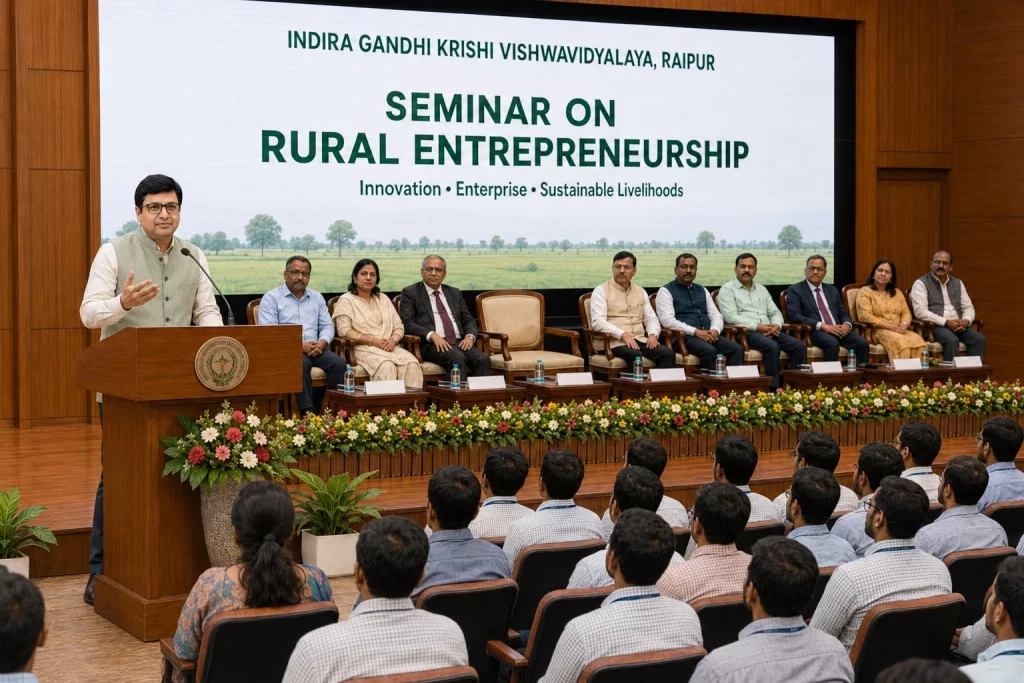
A seminar on “Rural Entrepreneurship: Innovation, Enterprise and Sustainable Livelihoods” was organised at Indira Gandhi Krishi Vishwavidyalaya (IGKV), Raipur, on 13 August 2026. Agricultural scientists, faculty members, researchers, students and aspiring entrepreneurs participated in the programme to discuss emerging opportunities in India’s rural and agricultural economy.
Rajeev Singh, Founder of Sansar Green, delivered the keynote address. A leading Indian agripreneur, environmentalist and natural farming expert from Jharkhand, Singh has extensive experience in sustainable agriculture, soil health, bio-inputs, plantation development and rural entrepreneurship. He has also shared practical agricultural knowledge as an expert on All India Radio and Doordarshan.
The programme was held in the presence of Prof. Girish Chandel, Vice-Chancellor of IGKV; Dr. Vivek Kumar Tripathi, Director of Research Services; Dr. S. S. Tuteja, Director of Extension Services; Dr. Arti Guhey, Dean; senior agricultural scientists and faculty members.
Addressing the students, Singh said that rural India should not be viewed merely as a source of agricultural raw materials. Its villages have the potential to become centres of innovation, processing, manufacturing, digital services, value addition and employment generation.
He explained that many farmers apply fertilisers and other agricultural inputs without adequately understanding the nutrient status of their soil. This can increase cultivation costs and adversely affect soil health and crop productivity. Soil testing, location-specific microbial solutions and crop-specific nutrient management can help farmers use inputs more efficiently.
Singh presented Sansar Green’s “Mitti Se Mandi Tak” model, which integrates soil diagnostics, soil- and crop-specific bio-inputs, artificial intelligence-based crop advisory, farmer training, produce collection, value addition and market linkage.
He highlighted the importance of developing beneficial microbial strains suited to local soil and climatic conditions. Agricultural solutions developed for one region may not provide the same results in another. Biofertilisers and biological crop solutions should therefore be selected according to the soil, crop, climate and nutrient requirements of each location.
Discussing opportunities for young entrepreneurs, Singh identified bio-input manufacturing, soil-testing services, nursery development, seed production, grain cleaning and grading, food processing, farm machinery services, digital crop advisory, agricultural logistics, packaging and direct-to-consumer marketing as promising rural business sectors.
He advised students to begin their entrepreneurial journey by identifying genuine problems faced by farmers and developing affordable, practical and scalable solutions. He emphasised that rural enterprises must earn farmers’ confidence through transparent communication, consistent product quality, field demonstrations and measurable results.
An interactive session was also organised during which students raised questions about startup funding, incubation, product development, technology commercialisation, certification, digital marketing and the challenges involved in establishing an agricultural enterprise. Singh shared experiences from his entrepreneurial journey and encouraged students to undertake field visits and interact directly with farmers before preparing their business models.
Prof. Girish Chandel highlighted the important role of agricultural universities in connecting scientific research with farmers, startups and rural industries. He underlined the need for entrepreneurship-oriented agricultural education that can encourage students to become innovators and employment creators.
Dr. S. S. Tuteja discussed the importance of strengthening cooperation among research institutions, agricultural extension services and rural entrepreneurs so that proven technologies can reach farmers more effectively. Dr. Vivek Kumar Tripathi highlighted the need to transform scientific research into practical and commercially viable solutions while maintaining quality and scientific credibility.
The programme concluded with a call for closer collaboration among agricultural universities, scientists, startups, farmers, government institutions and rural communities. The seminar reinforced the message that rural entrepreneurship can create sustainable livelihoods while improving soil health, agricultural productivity, local value addition and farmers’ access to markets.
Photo caption: Rajeev Singh, Founder of Sansar Green, delivering the keynote address during the Seminar on Rural Entrepreneurship at Indira Gandhi Krishi Vishwavidyalaya, Raipur, on 13 August 2026.